


Share This Article
What’s the future of sustainable fabric materials? Matteo Ward, CEO of Inside Out, shares his insight on sustainability and innovation.
Organic cotton. Recycled polyester. Bamboo-sourced Tencel. What is the most sustainable fabric of all? Over the last five years, “sustainable” has become a mainstay within the fashion industry. But, as a fairly new buzzword within the industry, it hasn’t come without its share of confusion. And nowhere else does there seem to be more confusion than with the foundation of a garment itself- fabrics.
Part of the problem is that there isn’t a clear consensus about what sustainable means, which has allowed fast-fashion brands to capitalize on sustainability through falsified marketing campaigns. “It has become genuinely difficult for people to distinguish what’s real from what’s fake, what’s safe from what’s harmful,” states Matteo Ward, the CEO of Inside Out’s Fashion, Textile, and Home vertical.
As an industry expert who spends his days strategizing with responsible fashion companies such as The Simple Folk and speaking at international conventions about innovations in the sustainable textile industry, Matteo brings clarity to difficult questions about responsible materials, sustainability, and the future of fashion. Here, he offers tips we can all adopt when choosing the best brands to support and building a sustainable wardrobe- one garment at a time.
What is your definition of sustainable fashion?
The word “sustainability” has, unfortunately, been used and abused in recent years, to the point that its true meaning has been diluted. Because we lack a universally adopted definition of “sustainable,” many players have begun defining it for themselves, using whichever frameworks best suit their own interests. This has often resulted in greenwashing.
And that’s a problem, first and foremost because it has become genuinely difficult for people to distinguish what’s real from what’s fake, what’s safe from what’s harmful. If everything is “sustainable,” then nothing truly is, right?
Ultimately, sustainable is an adjective that describes activities carried out in ways that preserve the life of all living things on the planet. Since no fashion brand today can reasonably substantiate such a claim, what we should be talking about instead is responsible fashion: products created with a deep awareness of the consequences and implications of their making, selling, and use—and designed in ways that help us mitigate our environmental impact while maximizing our positive impact on society.
What sustainable innovations are you excited about in the fashion industry?
I’m interested in innovations that reshape ideas, social and legal systems, and infrastructures, solutions that strike at the root causes of our crises: overconsumption, overproduction, social injustice, and environmental injustice. I’m focused on innovations that channel the breakthroughs we’re making in material science, AI, and production toward meaningful, positive impact, operating at the intersection of planetary and human health.
Do you think the fashion industry can shift away from polyester at scale?
Yes, but only if we stop treating the problem as a material problem and start seeing it as a system problem. Polyester is not dominant because it’s the best material; it’s dominant because we’ve built an entire industrial, economic, and cultural system that depends on it: ultra-low prices, ultra-fast turnaround, mass overproduction, and infinite volumes of disposable clothes. You don’t break that dependency simply by swapping one fiber for another. To truly shift away from polyester at scale, three things need to happen: we must address overproduction, we need innovation in systems, not just materials, and we must realign incentives: we need policies that reward impact, longevity, and circularity.
How does The Simple Folk fit into sustainable fashion under Inside Out?
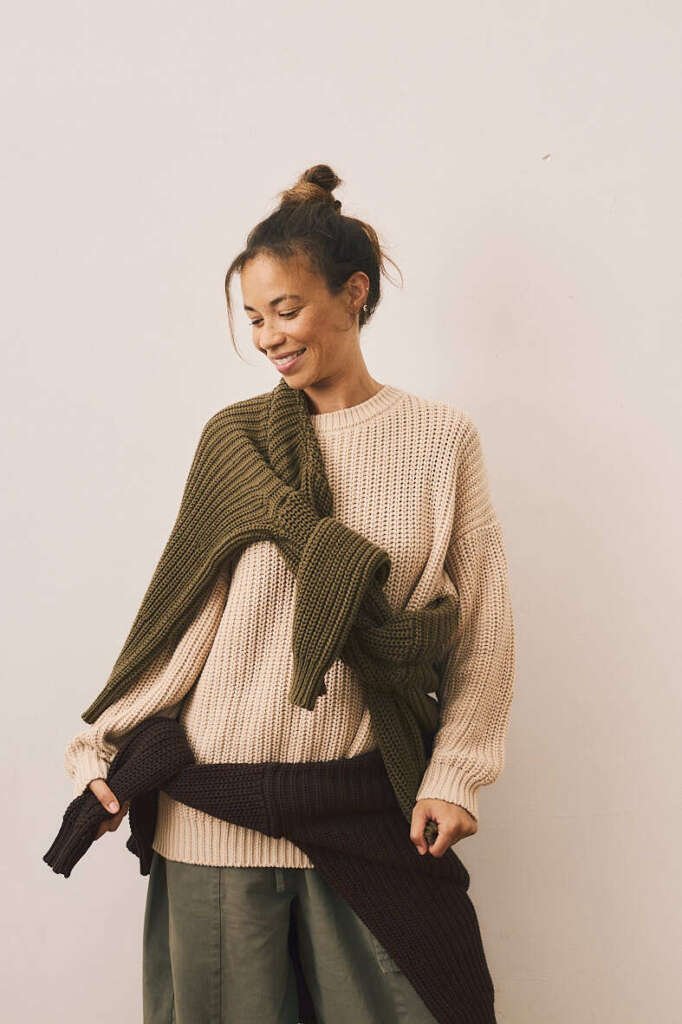
The Simple Folk Chunky Knit Cardigan is made from 100% organic cotton, knitted in India with GOTS-certified partners. $165
The Simple Folk has made a clear promise: to make responsible fashion choices simple for children and their families. This begins with trust, built through honesty, transparency, and integrity. Every decision Luis Gamardo (CEO of The Simple Folk) and his team take is guided first and foremost by the health and well-being of the children we dress.
To deliver truly healthy clothes, we must know every ingredient and every actor in our supply chain, because we cannot change what we cannot see. In the year ahead, the primary focus for The Simple Folk will be deepening engagement across the entire value chain, strengthening our chemical management protocols, and elevating our governance frameworks with an inclusive and collaborative mindset.
Are natural materials like cotton, linen, wool, and silk truly sustainable?
Unlike synthetic materials, natural fibers have the potential to create social and environmental value — which is why they remain the best option for the vast majority of garments. When challenges arise with natural fibers, they rarely stem from the material itself, but from the way we handle it: the ways we cultivate, process, dye, and finish these fibers can either protect or harm people and planet.
Are new textiles – mycelium, algae, or bamboo – sustainable solutions?
Some of these materials are interesting, but none of them is a silver bullet. Take bamboo, for example. Although it begins as a natural resource, it is often converted into viscose through chemically intensive processes. So when we read “bamboo T-shirt,” we have to remember that the garment holds only a distant memory of its natural origin; many transformative, and potentially harmful, steps have altered its cellulose along the way.
In general, materials are an important part of the equation, but never the solution on their own. Even when we work with excellent fibers, pure cotton, pure wool, or any innovative alternative, if the business model remains unchanged, the social and environmental value of the material is often weakened, if not completely erased, by overproduction and overconsumption.
Does a better material prevent an item from being produced by children or from being discarded in a landfill? No! “Sustainable” (or better, responsible solution) involve materials, yes, but materials are only one variable in a much larger and more complex system.
Dyeing is highly polluting. What innovations are making it cleaner?
Ancient wisdom teaches us to look to nature as a source for new generations of dyes, while strict chemical-management protocols ensure the accountability modern production requires. Yet the most meaningful innovation lies in collaboration: without economically and technically supporting dye houses, true impact will remain out of reach.
How are you sustainable in your everyday life?
I am not perfect, but I try to live in line with the principles I advocate professionally. I buy very little, repair what I own, choose low-impact options whenever possible, and avoid unnecessary consumption – I only buy things I either really need or fall in love with. But honestly, the older I get, the more I realise that my personal choices, while important, are only a small part of the story. My work is woven into my life, and I’ve come to believe that real impact comes from what we build together — the ecosystems of brands, suppliers, and people who decide to do things differently. That’s where transformation happens. Personal habits matter, yes… but they become powerful when they help shape something bigger than any one of us.
